The post Current trends in the VR Market and the Gaming Industry during the downturn appeared first on SVAIY ART.
]]>The virtual reality (VR) market and its associated gaming segment are experiencing a noticeable decline after a period of hype. Sales of VR hardware have decreased, and the pace of content adoption has slowed. This puts companies providing VR services at risk, as the temporary reduction in demand may negatively impact their revenues and valuation. However, for many market players, the downturn is cyclical, and prospects for the next 1–2 years are linked to an expected recovery in demand. Below, we examine key trends in demand for VR development, investor attitudes toward temporarily unprofitable companies with strong assets, examples of studios that have overcome challenges, and the impact of participation in industry exhibitions.
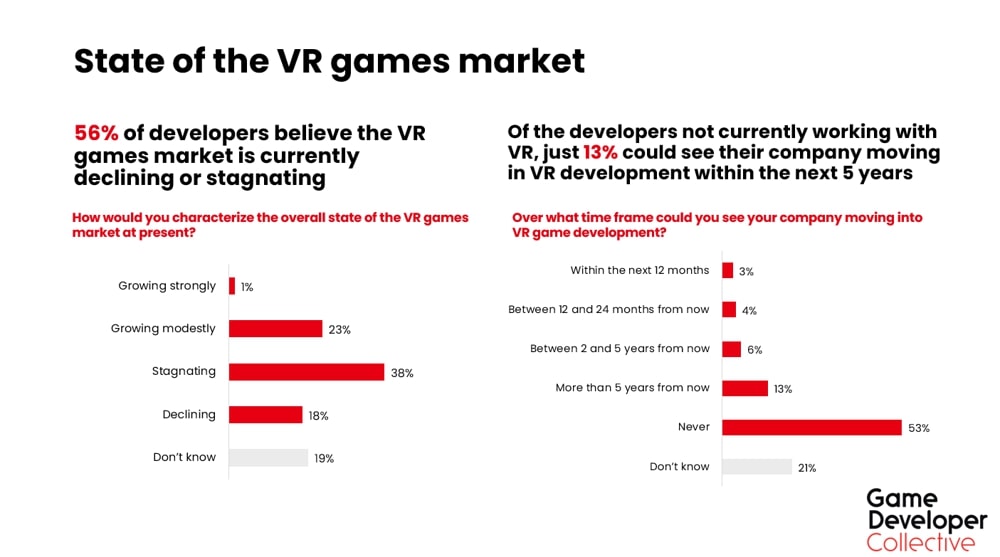
According to developer assessments, 56% of respondents consider the VR gaming market to be stagnating or declining, while only 24% see growth (Game Developer Collective survey data). This reflects the current low consumer demand and limited VR audience.
In 2023, the consumer VR market experienced a sharp decline. According to Omdia, global VR headset sales dropped by 24% (from 10.1 million units in 2022 to 7.7 million in 2023). The active user base has effectively stabilized (~23.6 million headsets), and only slight growth is expected in the coming years. At the same time, spending on VR content also declined: in 2023, users spent $844 million, compared to $934 million the previous year.
The reasons for the decline include a combination of economic factors (inflationary pressure on consumer spending) and disappointment in the technology: new devices lacked a “killer app” capable of attracting a mass audience. For example, even the high-profile launch of Apple Vision Pro did not bring about a revolution—developers estimate that Apple’s impact on the market remains minimal.
Most VR games remain niche, and development profitability is challenging due to the modest user base. As a result, 56% of game developers believe the VR gaming market is currently stagnating or shrinking. The main reasons are the high cost and inconvenience of headsets for the average user, as well as the absence of truly essential content. Many consumers are still not willing to wear a heavy device on their heads for long periods, and the novelty of VR games quickly wears off without deep replay value.
While purely entertainment-focused VR is hitting an audience ceiling, the use of VR in education, training, and the B2B sector is showing steady growth. Companies are increasingly adopting VR for employee training: analysts estimate that the VR education market will grow from $4.4 billion in 2023 to $28.7 billion by 2030 (an annual growth rate of ~30%). By 2030, enterprise users will generate more than 60% of all VR industry revenues.
The reasons are clear: VR training has proven to be effective and cost-efficient. For example, PwC research shows that VR training is four times faster than classroom training, and learners feel 275% more confident in applying acquired skills. VR allows for the simulation of situations that are either inaccessible or too expensive to recreate in real life (e.g., manufacturing, medicine, military training), increasing corporate clients’ interest in such solutions. Even during economic downturns, companies continue investing in VR training as a way to reduce costs and improve workforce efficiency.
Thus, demand for VR development is segmenting: while the gaming and entertainment sector is experiencing temporary stagnation, interest in education, training, and industry applications is growing. VR development studios focused solely on games now find it harder to attract clients, but expanding into related fields (edtech, simulations, marketing) can compensate for declining gaming demand.
During crises, investors become more cautious, which affects funding for VR/metaverse startups. In 2023, venture capital investments in VR/AR projects and virtual worlds fell to their lowest levels in recent years. Many funds shifted their focus to more applied fields, leaving consumer VR startups struggling with a funding shortage.
However, for companies with strong intangible assets and a long-term vision, investors still assess the potential for recovery, even if financial performance is currently negative. In the modern digital economy, intangible assets have become decisive: on average, they account for up to 87% of a company’s total value (including intellectual property, software, brands, and expertise). During periods of growth, this goes unnoticed, but in a crisis, their role becomes crucial.
According to the International Valuation Standards Council, brands and other intangible assets are now critical competitive advantages, and companies that know how to leverage them are more resilient during downturns.
When facing temporary unprofitability, investors look at strategic assets and long-term prospects. If a company has unique technology, patents, a strong team, or a loyal community, the market factors these into its valuation—even if current profits are negative.
For example, many major players continue investing in VR for the future: Meta (Facebook) incurs billions in annual losses in its VR division but sees this as an investment in the long-term metaverse. Similarly, a startup with negative cash flow but a unique VR engine or a popular game may receive an “advance of trust” from investors.
Experienced investors use downturns as opportunities to invest in promising companies at lower valuations, expecting value growth when the market recovers. In past crises, leading funds adopted this strategy: although startup valuations fell by an average of 25–40%, the best projects still secured capital—sometimes even more easily, as there was less competition for deals.
The current downturn has affected many VR studios, including well-known ones. In late 2024 – early 2025, several leading VR game developers announced staff cuts due to weak sales.
For instance, Swedish studio Fast Travel Games (creators of several successful VR games) had to lay off 30 employees out of ~70 after six game launches in 2024 with sales below expectations. The company’s leadership explicitly pointed to an “uncertain year ahead for VR games” and the need to reduce costs for future stability.
Similar reports came from other studios: in October 2024, UK-based XR Games cut ~40% of its staff, in September 2024, nDreams laid off up to 17% of its workforce, and in January 2025, Soul Assembly announced ~15% layoffs. These cases illustrate that even experienced teams struggle with the profitability of VR projects in a contracting market.
Despite the challenges, some VR developers have successfully adapted. Facing low consumer demand, certain studios have pivoted toward corporate sectors or adjacent services.
For example, U.S.-based PIXO VR initially focused on VR entertainment but shifted to VR training for businesses. They leveraged their gaming development and artistic expertise to create immersive training modules (e.g., industrial safety) and implemented a new sales strategy. This pivot into VR education quickly paid off: inbound leads quadrupled, and contracts with several Fortune 500 companies were secured.
Another example is the startup Pixvana, which realized in 2019 that the mass market for its VR video platform was not yet ready. Instead of shutting down, the team changed its product niche—leveraging its video expertise to create Voodle, a new short video messaging service for team communication. In essence, Pixvana exited VR entirely, but this move allowed it to retain its team and investments, avoiding failure due to a narrow market.
For gaming studios, a common strategy is to scale down and wait for the next market growth phase. Fast Travel Games, in addition to layoffs, secured additional funding—in spring 2024, it received investment from MetaVision, providing financial stability for future projects. The studio also reported reaching one million cumulative game sales, demonstrating portfolio value to investors.
The key to surviving a crisis in the VR market is maximum adaptability. The studios that successfully navigated the downturn optimized costs, diversified their business, and preserved the value of their intangible assets (technology, IP, or team).
Market recovery is expected by 2026, so the challenge for VR companies is to endure until then—while simultaneously developing new opportunities to emerge from the downturn stronger, not weaker.
The post Current trends in the VR Market and the Gaming Industry during the downturn appeared first on SVAIY ART.
]]>The post Overview Of Key Events in VR: January 2025 appeared first on SVAIY ART.
]]>In January 2025, many important events took place in the VR/AR world. In this short roundup, we collected the most interesting news illustrating how the industry is developing.
According to a GDC survey, 35% of game developers focus on creating projects for XR platforms, which include VR, AR, and MR. This statistic shows rapid growth in interest in XR among the gamer community compared to past years. For example, this rate was only 25% last year. Besides, many respondents pointed out that they are waiting for investment growth in that sector for the next 2-3 years.
The image belong to GDC
That is a standalone device with no need for connection to a PC or console, and it suggests high-end optical technologies specially created for corporative usages, such as virtual training or remote work. The headset will be on the market this month for a price of $4,750, which puts it in a direct competitive field with Apple Vision Pro. As expected, SRH-1S will get interest from businesses that intend to integrate MR technology into their work process.
Meta, according to unofficial sources, is actively developing the next generations of its popular VR headsets – Meta Quest Pro 2 and Meta Quest 4. It is expected that the new devices will have improved displays with higher resolution and a wider field of view, improved motion tracking, and new controllers. Although no release dates have been announced yet, analysts predict a release in the second half of 2025. In addition, Meta plans to improve social media integration to create a more social VR experience.
At the latest Samsung Unpacked event, the company’s XR headset, which runs on Android, was presented for the first time. The device doesn’t use traditional controllers, instead, it replies to hand tracking and voice commands. One of the standout features shown in the video is Gemini’s AI integration. Because the cameras see what you see, you can ask the AI questions about the environment and get a response. Although there is no official information on price and availability yet, Samsung said that the headset should go on sale “sometime this year.”
NVIDIA has taken a big step forward and announced that its GeForce Now cloud gaming service now supports several popular VR headsets, including the Apple Vision Pro, Meta Quest 3, and Pico. This means that users can play their favorite computer games in VR in resolutions up to 4K and at 60 FPS using only the browser on their headset. The service supports more than 2,000 games, and that could be a significant boost for the spread of VR systems in the gaming community.
The post Overview Of Key Events in VR: January 2025 appeared first on SVAIY ART.
]]>The post How VR Transforms Physical Activity appeared first on SVAIY ART.
]]>In today’s world, where technology permeates all aspects of our lives, the fitness industry is no exception. AI and VR are opening up new possibilities for training, making it more effective, interesting, and accessible, even without leaving home. Virtual reality opens up new possibilities for training on simulators, making them more exciting and interesting. Thanks to VR, you can forget about the monotony and boredom during training and immerse yourself in a world of virtual adventures.
Virtual reality opens up new possibilities for training on simulators, making them more exciting and interesting. Thanks to VR, you can forget about the monotony and boredom during training and immerse yourself in a world of virtual adventures. Integrating fitness and gaming allows you to use technology to make exercise more engaging. From stretching games to fitness-focused virtual reality, there are countless ways that games can increase physical activity.
VR games encourage participants to be physically active in a fun and engaging way. By making exercise fun, they help combat sedentary lifestyles and promote overall health.
It didn’t take long for VR fans playing high-energy games like Beat Saber and Pistol Whip to realize that virtual reality isn’t a sedentary gaming experience—it’s possible to get a sweaty and exhausting workout while wearing a VR headset like the Oculus Quest, which has become a sort of fitness tracker as well. Oculus Move is a built-in app that tracks minutes spent actively moving and estimates calories burned across all your apps. There’s no need to rely on a developer to build fitness tracking into an action game—this turns every app on the headset into a fitness app automatically.
Many of us still play games like we did a decade ago—on a screen with a handheld controller. Getting us moving while playing could be key.
Prof Craig’s academic career at Ulster University focuses on perception and the study of movement, and she is a former rugby player herself. She is now the chief executive of Incisiv, a Belfast-based technology company that develops virtual reality games and training aids. “We’re very much interested in how we can use the power of gameplay to really get people moving, to really improve their performance as well,” she told BBC News NI.
Some companies are developing dedicated interactive fitness platforms that use VR and other technologies to create unique training experiences. For example, the Black Box VR platform offers virtual boxing workouts using special gloves and sensors that track your movements and punches.
It can be concluded that training in virtual reality is more interesting and exciting than traditional training on simulators. You forget about fatigue and monotony, completely immersing yourself in the virtual world and enjoying the training process. This helps to maintain motivation and regularly engage in sports. VR offers a wide selection of workouts and games, which allows you to diversify your fitness routine and avoid monotony.
You can choose different types of activities, locations, and levels of difficulty, which makes training interesting and suitable for any level of physical fitness. VR technologies are becoming increasingly accessible, and today, you can purchase a VR headset and the necessary software at a reasonable price. This makes VR fitness accessible to a wide range of users.
The post How VR Transforms Physical Activity appeared first on SVAIY ART.
]]>The post Most Popular VR Headset On The Market | 2025 appeared first on SVAIY ART.
]]>It turns out that the experience you get during VR sessions depends on the headset you use. Today, there are a number of studies, such as the one by ResearchGate, in which the authors investigate how people perceive the quality of different virtual reality headsets. The authors remark that quality depends not only on hardware but also on how comfortable you are with a particular headset while using it.
Therefore, it’s about a balance between performance, comfort, and ease of use. After all, the best VR headset doesn’t necessarily have the highest resolution or the most powerful processor. So when you buy one, it’s not just the specs that matter, but also how it fits, whether it feels right, and how intuitive you find the controls.
Let’s inspect what kind of VR headsets are available on the market today and see what they are all about. According to PCMag, Engadget, and PC Gamer, the best VR headsets combine a balance of performance, comfort, and affordability.
Meta is popular because it has an excellent price-performance ratio. Therefore, it is a reliable choice for beginners and more experienced VR users. By purchasing Meta, you get a clear display, a sufficient refresh rate, and a smooth and clear VR session.
In addition, this headset is wireless and this is a plus because you are not tied to a PC or console. Of course, the downside is that the battery life is not very long, about 2.5 hours, so you will have to charge it more often than you would like.
Now, the Valve Index is for you if you’re serious about VR and don’t mind spending more money. This model offers one of the best displays among VR headsets, with a high refresh rate that makes everything look incredibly smooth. The ergonomics of the controllers, along with hand tracking, are also top-notch.
The catch is the price, and you need a powerful computer to respond to all the bells and whistles of this headset.
If you’re a PlayStation fan, PS VR2 is your choice. These glasses are designed specifically to work seamlessly with the PlayStation 5 and its exclusive games. The display is clear, and the haptic feedback grants a better immersion.
However, you should realize that the headset is limited to PlayStation, so if you don’t have a PS5, you shouldn’t consider it. It’s also wired, so if you’re used to wireless devices, it may be a bit uncomfortable at first.
If you want extra-detailed images, consider it. This headset boasts the highest resolution in its class. The resolution has increased from 2.3 MP (1440×1600) per eye to a whopping 6.0 MP (2448×2448) per eye. HTC Vive Pro 2 is also the first headset to support streaming compression, enabling it to handle massive bandwidth. It is ideal for simulations and games.
Like the Valve Index, it is more expensive and requires a powerful PC. It’s also a bit heavy, which can tire you out during long sessions.
It’s not as well known as its predecessors, but it offers a good balance between price and features. The cool display and lightness make it comfortable for long periods of use. The main disadvantage is the compatibility with programs and games, as Meta or Valve offers a wider choice of apps and games.
The latest is the Apple Vision Pro for today. Immediately, we are hit by the sleek design with its smooth lines. Its high display resolution – 3660×3200 and HDR support – also stands out. It is equipped with a powerful M2 processor, which gives high performance even in demanding programs.
If you’re a fan of Apple and already use its products, the headset integrates seamlessly with the Apple ecosystem, which is great. However, it’s pricey compared with others, and the battery lasts about two hours. It should be noted that most wireless VR headsets have an average battery life of about 2 hours.
In conclusion, the choice of a VR headset depends on your needs. If you want something affordable and wireless, Meta Quest is a great choice. If you want the best visuals available today and the price is not the first thing on your mind, then Valve Index or HTC Vive Pro is the way to go. Each headset has its pros and cons, so consider what matters to you and make your choice.
The post Most Popular VR Headset On The Market | 2025 appeared first on SVAIY ART.
]]>The post Virtual Showrooms: A New Sales Format In VR appeared first on SVAIY ART.
]]>A time when VR technologies were no longer interactive is behind us—they have now become part of marketing and corporate innovation. A VR showroom is an interactive virtual space that allows customers to view and evaluate products through virtual eyepieces or a computer screen. This is a new form of shopping center that allows shoppers to buy goods in a realistic virtual environment.
A VR showroom has several advantages for businesses:
Also, a showroom in virtual reality is an important tool for business, as it allows you to save money, improve the display of goods, and promote sales conversion.
VR allows customers to interact with products in a more immersive way. They can “try on” the product or interact with it in a virtual environment, which helps them make better purchasing decisions.
In this way, it is easier for the seller to remove the possible restrictions of buyers until the purchase is complete, and it is also easier for them to become interested in it.
Retailers are using both VR, where customers typically wear a headset to enter a completely digital world, and AR, which overlays digital projections onto the real world and can be accessed on a smartphone. Such technology is being used to sell products that shoppers have traditionally been reluctant to buy online. Furniture is one example where consumers want to see the size of items to check how they fit into their homes, writes Bernard Marr in Forbes.
Now IKEA’s The Place App allows customers to do just that by projecting a digital version of the chair or table into the room where it is going to end up.
Here are some successful cases of VR/AR use:
Shopping is about to get personal. Virtual assistants powered by AI are already guiding customers through their online shopping experiences, making personalized recommendations that lead to more sales and more loyalty. Brands that incorporate personalization like this into their digital commerce strategy have reported a 71% increase in customer loyalty.
But this is just the beginning. In the future, these assistants will be more than just chatbots. They’ll act as personal shopping guides, learning the preferences of each customer and scrolling through thousands of variants to suggest the perfect products for their needs.
By 2030, this software will have been integrated into everyday apps, and it has the potential to give customers intelligent shopping suggestions as they get dressed—and bring it all to life with VR.
The post Virtual Showrooms: A New Sales Format In VR appeared first on SVAIY ART.
]]>The post How VR Becomes a Benefit in the Biology Education appeared first on SVAIY ART.
]]>Nowadays, technology is able to provide education with more interactive approaches in the beginning, which in turn leads to the promotion of deeper and better knowledge acquisition. Visualization of complex systems and structures in 3D helps to explore and understand elements that are often difficult to learn using traditional teaching methods.
Students can examine the human or animal body interactively, providing a detailed view of the inner body structure. This method lets them see the interconnections in the body, which is especially useful for understanding complex systems such as the circulatory or nervous systems.
Imagine being able to explore different ecosystems, and observe their flora and fauna while in their environment without leaving the classroom or your office. All this can be achieved by introducing VR into educational processes. This experience allows us not only to look deeper into the processes taking place in the environment but also to see how certain ecological interactions are realized.
You can bring processes such as cellular functions, DNA replication, or viral infections to life, making abstract concepts more understandable and visual. Such visualization allows us to better understand this micro-universe of biology. For example, it is possible to demonstrate how viruses infect cells, which provides insight into viral structures and mechanisms.
According to the investigations mentioned below, the benefit of VR in the learning process is increased student motivation. Visualization guides to better retention of information and a deeper understanding of various biological systems. Introspections show that learners who use virtual reality in biology classes enjoy it more and perform better.
While VR suggests significant benefits, it is also worth considering the requirements and challenges that can appear. Some students may feel uncomfortable or dizzy during long sessions. In addition, integrating it into the curriculum requires as much financial investment as teacher training to use the equipment effectively.
Thus, virtual reality is a powerful tool that can improve biology education, providing a presentation that makes complex concepts accessible and engaging. It is not difficult to understand that with the development and spread of technology, virtual reality will play an increasingly important role in education in general.
The post How VR Becomes a Benefit in the Biology Education appeared first on SVAIY ART.
]]>The post Evolution of Gaming in the Metaverse appeared first on SVAIY ART.
]]>The gaming industry is always moving forward, from simple pixels on a screen to advanced graphics and blockchain technologies that revolutionize in-game economies where players can own real virtual assets.
Metagames – an area where digital and physical realities combine within interactive space and transform entertainment. This interaction not only changes how we play games but also changes how we cooperate, learn, and do business. This change goes beyond the borders of the world, affecting communication, lighting and commerce. Games play a central role in the evolution of future gamification.
In the metaverse, games are not an isolated part; it is an interconnected digital universe with possibilities.
The advent of the internet marked another important step in gaming history. It opened a new era of multiplayer games and online worlds. Games like World of Warcraft and Eve Online enabled players to collaborate globally within shared virtual universes. These games developed a strong economy and narrative system that continued to prosper as long as people logged off. Meanwhile, progress in 3D graphics brought realism to gaming. Titles like The Legend of Zelda: Ocarina of Time and Final Fantasy VII showcased visually stunning and emotional experiences.
The rise of smartphones opened the new era of mobile gaming, making games more accessible. Titles like Angry Birds and Candy Crush Saga turned millions into casual gamers, while Pokémon Go offered augmented reality (AR) gaming by blending digital gameplay with physical exploration.


The gaming landscape of the metaspace has fast evolution, giving a variety of chances to people all over the world – from virtual worlds to social games.
Virtual Reality (VR) and Augmented Reality (AR) take a central role in the metaverse evolution. VR provides fully immersive experiences, allowing players to step into virtual worlds, while AR blends virtual elements with the physical world. These technologies deliver a high level of diving in the metaverse gaming process. According to Grand View Research, the global VR market is expected to reach $62.1 billion by 2027.
Games like Half-Life: Alyx demonstrate VR potential, while Pokémon Go showcases AR’s massive engagement. The role of these technologies in metaverse gaming will only grow.


Blockchain technology is another important part of the metaverse. Its decentralized structure is ideal for managing virtual assets and in-game transactions. Coupled with Non-Fungible Tokens (NFTs), blockchain revolutionizes game economics and allows players to truly own game items and characters. NFTs can be bought, sold, or traded on the blockchain, often for real-world currency. For example, CryptoKitties showcased the economic potential of NFTs, with some virtual cats selling for over $100,000.
Axie Infinity pioneered the play-to-earn model, allowing players to earn cryptocurrency through gameplay. This innovative approach has created a new gaming economy where virtual assets take real-world value. As more games use this model, the metaverse is becoming a hub not for only entertainment but for economic opportunities too.
The world of metagames offers big economic opportunities for players and creators. Virtual real estate has become goods that players can buy, sell, and develop. These virtual spaces are used as hubs for game activities or digital storefronts, growing the economy of digital assets.
NFTs have transformed digital ownership in gaming, assets, characters, or even virtual land. Players can exchange these assets across platforms or sell them for cryptocurrency. User-generated content also thrives in the metaverse, as players design skins, build virtual worlds, and create gaming experiences, earning income from their digital products.
Community building is an important element in the development of metaverse gaming. Instead of isolated experiences, the metaverse expands collaboration, competition, and social connection. Players team up for quests, compete in tournaments, or socialize in virtual environments. Platforms like Roblox, Fortnite, and Zepeto have become social hubs where players not only game but also attend concerts, play with friends, and take part in virtual fashion shows. This redefines online communities and social networks.
Despite the high potential, metaverse gaming faces technical limitations, high costs, and age restrictions on content. However, these challenges are opportunities for innovation and growth.
As technology evolves, the metaverse continues to revolutionize the gaming industry, combining entertainment with economic opportunity and growing digital communities. With the integration of VR, AR, blockchain, and NFTs, the future of gaming in the metaverse looks more effective and near than ever
The post Evolution of Gaming in the Metaverse appeared first on SVAIY ART.
]]>The post December: What Happens in VR This Month appeared first on SVAIY ART.
]]>December has been a busy month for the VR industry, with exciting developments across gaming, hardware, and accessories. Here’s a quick look at the most notable updates:
1. VR Development progress of Fallout: London
Modder Raezroth Elnheim Fallout: London has begun adapting Fallout: London for VR. Raezroth says that the VR version of Fallout: London “is currently an experimental project,” but he notes that he’s “interested in making a full VR podge for Fallout: London.”
2. Skydance’s Behemoth released new patch
Skydance’s BEHEMOTH, a VR game from Skydance Games Studio, was released on December 5. Players praised the game, its story, combat mechanics, and engaging battles. But it wasn’t without its problems. Namely with performance. Today, on December 12th, a patch was released that solves performance issues, and bugs in boss battles, and improves AI, which should improve the stability of the game on Quest, PSVR 2, and PC VR.
3. Roto VR raises additional funding
Roto VR is set to raise £2.4 million in investment to meet demand for its recently launched Roto VR Explorer chair. Roto says the funding will support its next phase of growth following the launch of the Roto VR Explorer chair, which hit the market in November 2024.
It should be noted that the chair features a patented head tracking system to align users’ gaze when rotating the chair for better immersion and this solves the problem of motion sickness. It is compatible with over 400 games and apps from Meta Store.
4. Co-op mode in Green Hell VR for Quest and PSVR 2
Incuvo’s VR adaptation of Green Hell is launching its highly anticipated co-op mode on December 16 for Quest and PSVR 2. The update will allow for up to four players to play in a group. Currently, the co-op mode is still limited to certain platforms, so bringing co-op to Meta Quest and PSVR2 is extremely important for their VR community.
5. Haptic gun from StrikerVR is avaliable for pre-order
StrikerVR’s haptic gun is now available for pre-order. It costs $499 and is compatible with Quest 3 and Quest 3S headsets. Currently, there is support for three games such as Tower Tag, and Laser Limbo, and the company promises more games in 2025.
With realistic recoil and six-degrees-of-freedom tracking, Mavrik will make the gameplay of shooters in the virtual world even cooler.
The post December: What Happens in VR This Month appeared first on SVAIY ART.
]]>The post Demographics and Behavioral Trends of VR Users appeared first on SVAIY ART.
]]>Virtual Reality (VR) has experienced remarkable growth, revolutionizing fields such as entertainment, education, and business. Understanding the demographics and behavioral trends of VR users is critical for tapping into this dynamic industry. Below, we explore the data and insights shaping VR user engagement, supported by diverse research sources.
Younger generations dominate VR adoption, with Millennials (60%) and Gen Z (55%) showing the highest familiarity. This contrasts with Gen X (35%) and Baby Boomers (17%), indicating a generational gap in VR engagement. Gen Z users, in particular, demonstrate significant interest in immersive virtual experiences, such as virtual stores (33%) North America leads the VR market, accounting for over 40% of global market share as of 2023. This trend is expected to persist through 2030, driven by technological advancements and increased adoption rates in the region.
Despite its growing popularity, VR adoption among gamers is relatively low. For instance, only 2% of Steam users currently own a VR headset, highlighting untapped potential within gaming communities.
The primary motivations for using VR include:
Gaming and socializing emerge as popular VR activities, each engaging approximately 23% of users.
Challenging broader VR adoption includes:
Over 5nesses are now integrating VR into their workflows, particularly in training and education. Research shows that VR training can boost learning efficacy by 76% compared to traditional methods. This highlights its potential for professional development.
The VR insubstantial expansion. Consumer hardware shipments are expected to increase by 25% between 2023 and 2028, reaching 27.25 million units. Moreover, the extended reality (XR) market—encompassing AR, VR, and MR—is projected to surpass $100 billion by 2026.
Beyond gamindes in promoting empathy and understanding. For instance, MIT’s “The Enemy” uses VR to humanize opposing sides in global conflicts by sharing personal narratives. Similarly, Stanford’s VR Design Lab explores applications such as creating virtual sacred spaces and educational tools for functional harmony in music, demonstrating VR’s versatility across cultural and educational domains.
The demographics and behavioral trends of VR users underscore that Millennials and Gen Z dominate the space, there is significant room for growth among older demographics and non-gaming applications. By addressing barriers and leveraging VR’s unique appeal, the industry is well-positioned for sustained expansion and innovation.
Sources:
The post Demographics and Behavioral Trends of VR Users appeared first on SVAIY ART.
]]>The post A Sincere Thank You to Unreal Engine for Showcasing Our Artist Work appeared first on SVAIY ART.
]]>Our team at SVAIY ART is thrilled to express our deepest gratitude to Unreal Engine for featuring our artist’s work in the News and Community Spotlight on May 18, 2023. This recognition has not only brought attention to the incredible talent of our artists but has also helped to strengthen the bond within the digital art and game development community.
Unreal Engine has consistently been a driving force in game development and digital art, providing cutting-edge tools and resources for creators to bring their visions to life. Their dedication to showcasing the best of the industry has significantly impacted the careers of countless artists and developers, and we are honored to have our artist’s work included in their prestigious platform.

The News and Community Spotlight on May 18, 2023, was a testament to the diverse and vibrant digital art scene that Unreal Engine champions. Our artist’s work was featured alongside other exceptional projects, highlighting the unique perspectives and creative expressions that make the digital art world captivating.
We want to thank the Unreal Engine team for their unwavering commitment to promoting and celebrating the arts within the game development community. Their tireless efforts have not gone unnoticed, and we are truly grateful for the opportunity to have our artist’s work showcased on such a respected and influential platform.
Dubai on Mars 8
Unreal Engine Forum
The journey to Mars will be challenging–this was felt by Yevhen Kryvenko and the team who took on that challenge for a VR and cinematic experience!
In closing, we again express our deepest gratitude to Unreal Engine for featuring our artist’s work in the News and Community Spotlight on May 18, 2023. We look forward to future collaborations and continued support from the Unreal Engine community. Together, we can continue to foster a thriving and inclusive digital art world that celebrates the unique talents and visions of artists and developers from all walks of life.
Thank you, Unreal Engine, for your invaluable contribution to the digital art and game development community and for shining a light on our artist’s work.
The post A Sincere Thank You to Unreal Engine for Showcasing Our Artist Work appeared first on SVAIY ART.
]]>